

EU4ADMIN – From Project to Practice: Agreements Signed for Sustainable Administrative Data Exchange
As part of the project “EU Support for Increasing the Use of Administrative Data Sources in the Production of Official Statistics in Bosnia and Herzegovina – EU4ADMIN”, a ceremony for the signing of inter-institutional cooperation agreements was held in Sarajevo.
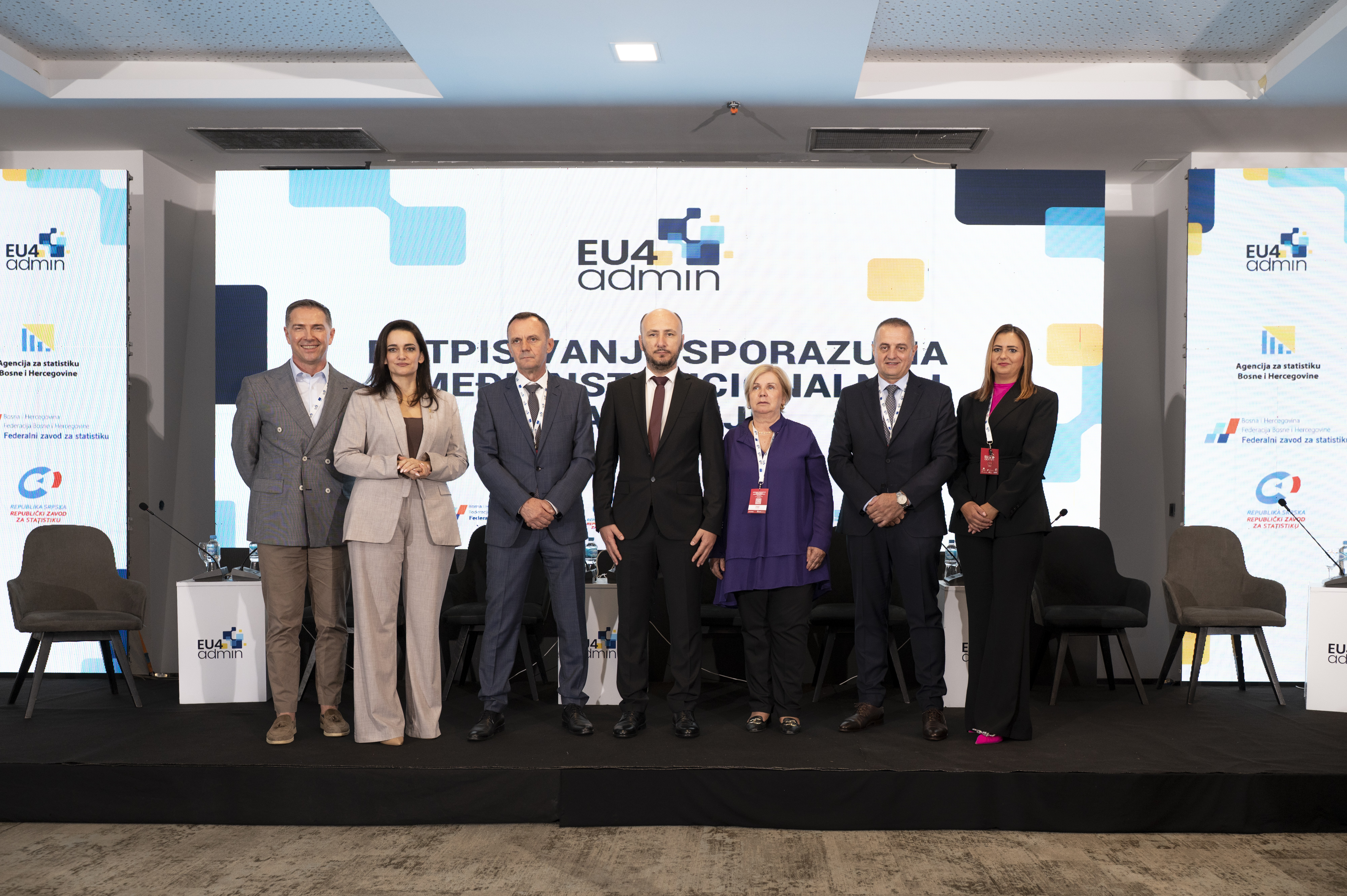
The agreements signed today confirm cooperation between statistical institutions and some of the key holders of administrative data in the areas of crime and demography, tourism, transport, environment and education. The agreements and technical protocols concern cooperation with the High Judicial and Prosecutorial Council of Bosnia and Herzegovina, the Service for Foreigners’ Affairs, the Indirect Taxation Authority of Bosnia and Herzegovina and the Directorate of Finance of Brčko District of Bosnia and Herzegovina.
The agreements are the result of almost three years of work aimed at strengthening cooperation between statistical institutions and holders of administrative data. EU4ADMIN focused on creating the legal, methodological, organisational and technical conditions necessary for data already generated through the regular work of public institutions to be used more securely, systematically and effectively in the production of official statistics.
Gayelle Nizery, Head of Section at the Delegation of the European Union to Bosnia and Herzegovina, emphasised that better use of existing data can reduce duplication and the need to collect the same or similar data multiple times from citizens, businesses and institutions, while contributing to higher-quality and more timely information and more efficient public administration.
“This is particularly important in the context of Bosnia and Herzegovina’s path towards the European Union. As the country advances in the accession process, the systematic use of administrative data should help Bosnia and Herzegovina strengthen its statistical capacities, respond more efficiently to growing European data requirements, and provide the information needed to monitor reforms and assess progress across numerous areas of the accession process. At the same time, secure data exchange, interoperability and the responsible reuse of information held by public institutions are part of a broader transformation towards a modern, digital and better connected public administration,” Nizery said.
Vesna Ćužić, Director of the Agency for Statistics of Bosnia and Herzegovina, stressed that today’s signing represents an important step towards making the cooperation developed through the project part of the institutions’ regular work.
“The greatest value of the agreements we are signing today lies not in the documents themselves, but in the trust that has been built between institutions and in the commitment to continue developing relationships that will deliver concrete results in the years ahead. Cooperation produces the best results when it is based on clear rules, mutual trust and shared responsibility,” Ćužić said.
The signed agreements and technical protocols define in greater detail the datasets to be exchanged, the method and format of their delivery, frequency and deadlines, institutional responsibilities, as well as issues related to confidentiality, data protection and secure data handling.
In addition to strengthening institutional cooperation, the project also included the development of IT solutions tailored to statistical needs, including applications for short-term business statistics and for crime and demography statistics, with the aim of improving the quality and efficiency of statistical production.

Today’s signing does not mark the end of the cooperation process initiated through EU4ADMIN. The project has also opened opportunities for cooperation with other institutions, while activities aimed at establishing and formalising new models of data exchange continue in other areas.
The EU4ADMIN project is funded by the European Union, with the Statistical Office of the Republic of Slovenia and the Croatian Bureau of Statistics serving as consortium partners.