

Agency for Statistics of Bosnia and Herzegovina Marks European Statistics Day
The Agency for Statistics of Bosnia and Herzegovina today, 20 October, marked the tenth anniversary of European Statistics Day with a gathering of representatives of institutions, users and providers of statistical data, as well as domestic and international partners.
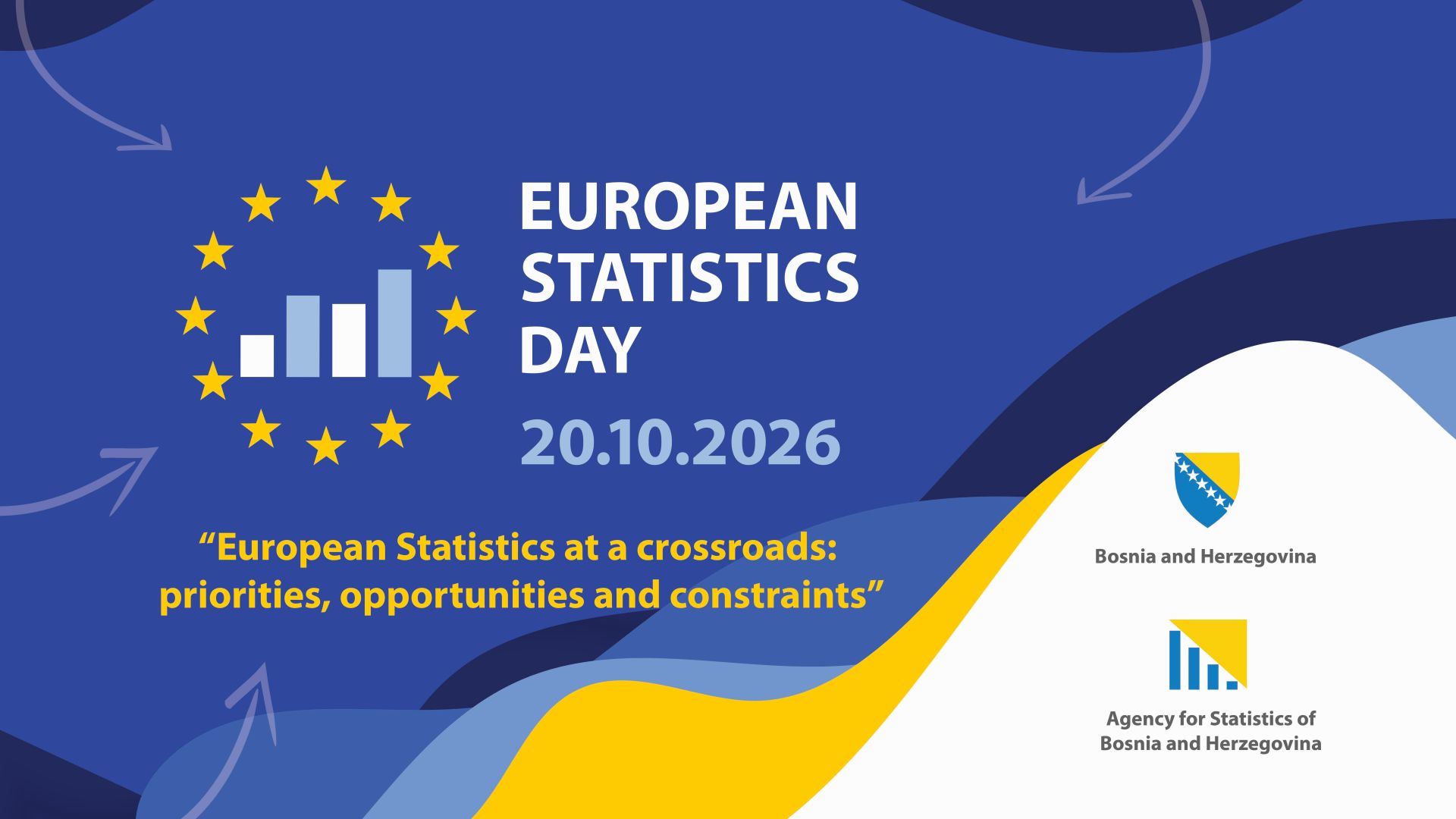
This year’s European Statistics Day is being observed under the motto “European Statistics at a Crossroads: Priorities, Opportunities and Constraints”, highlighting the challenges faced by official statistics in a time of rapid technological development, new data sources and growing user expectations.
Opening the event, Vesna Ćužić, Director of the Agency for Statistics of Bosnia and Herzegovina, stressed that official statistics today faces a dual challenge: to produce data more quickly and make them more accessible and understandable, while at the same time safeguarding their quality and reliability.
“Today, official statistics is expected to be faster, more accessible and easier to understand, to make use of new technologies and new data sources, while at the same time preserving what represents its greatest value – quality, professional independence and users’ trust,” Ćužić emphasised.
She identified the increased use of administrative data already available in the records of public institutions as one of the key directions for modernisation. Instead of collecting the same data again from citizens and businesses, their use for statistical purposes can reduce costs and the reporting burden, accelerate statistical production and enable the development of new statistical indicators.
A concrete step forward in this direction was achieved through the EU4ADMIN project, which strengthened cooperation with institutions holding important administrative records. Cooperation and data exchange agreements were signed with the High Judicial and Prosecutorial Council of Bosnia and Herzegovina, the Service for Foreigners’ Affairs, the Indirect Taxation Authority of Bosnia and Herzegovina and the Directorate of Finance of Brčko District of Bosnia and Herzegovina. Agreements with several additional institutions are currently being finalised, with the aim of further expanding the network of administrative data sources that can be used for statistical purposes.
From Statistical Publications to New Ways of Using Data
The programme continued with presentations of several statistical products, new methodological solutions and activities through which the Agency seeks to make data more accessible and useful to the wider public.
The new edition of the publication “Bosnia and Herzegovina in Figures” was presented by Alen Mrgud, Head of the Editorial and Publishing Department. The publication provides, in one place, an overview of the most important statistical indicators relating to population, the economy, education, the labour market and other areas of social and economic life. It enables users to access key data on Bosnia and Herzegovina quickly and easily.
The SDG Portal of the Agency for Statistics of Bosnia and Herzegovina, presented by Ševala Korajčević, Head of the Environment, Energy and Regional Statistics Department, brings together indicators showing the extent of Bosnia and Herzegovina’s progress towards achieving the United Nations Sustainable Development Goals, covering areas ranging from health and education to the economy, energy and environmental protection.
The results of the application of the international DEGURBA methodology were also presented. This methodology enables a clearer distinction between cities, towns and semi-dense areas, and rural areas. Using data from the 2013 Population Census, the Agency has laid the foundation for a more detailed assessment of differences between areas in Bosnia and Herzegovina, providing a more precise picture of territorial disparities, living conditions and development needs.

Bringing Statistics Closer to Young People: Secondary School Competition Announced
A special part of the programme was dedicated to statistical literacy, namely the ability to understand, correctly interpret and critically use statistical data.
On this occasion, the Agency announced the organisation of a statistical competition for secondary school students, planned for the 2026/2027 school year. The initiative was presented by Ivona Bulić, Head of the Public Relations Department.
The aim of the competition is to enable students, through practical work with real statistical data, to develop analytical skills, learn how to identify reliable sources of information and independently draw evidence-based conclusions. Through this initiative, the Agency aims to demonstrate that statistics is not merely a collection of numbers and tables, but a tool that can help young people better understand society and the world around them.
The event concluded with a discussion with participants on the use of statistical data, users’ needs and opportunities to make official statistics even more accessible and easier to use.
European Statistics Day was first observed on 20 October 2016, at the initiative of the European Statistical Advisory Committee (ESAC), with the support of the European Statistical System (ESS) and the European System of Central Banks.
Ten years later, technologies and methods of statistical production have changed significantly, but its fundamental purpose remains the same – to provide reliable, objective and comparable data that help citizens, institutions, the business community and researchers make informed decisions.
This is also illustrated, in a simple and engaging way, by the video prepared for the first European Statistics Day in 2016, which we are highlighting again on the occasion of its 10th anniversary: